Leadership, Authority, and Emotional Intelligence – A Case Study from the PECO Nuclear Turnaround

Abstract: The following is written from a practitioner’s point of view. The hypothesis is that organizations that respect the role of emotion in human systems, in concert with other variables such as role, goal, and decision clarity, will meet or exceed their performance expectations. The desire outcome has been achieved again by the author, and by the author’s mentor and father, Applied Behavioral Scientist Dr. Robert P. Crosby, dating back to the 1960s. The methodology and the results will be discussed.

Research consistently demonstrates that Emotional Intelligence is the critical variable in professional performance. This is especially true in a hierarchy, where authority relationships are prone to irrational behavior by both bosses and subordinates. Drawing on experience within the US nuclear industry, the author concludes that if hierarchical relationships are managed in a rational manner, so as to encourage an open flow of information, then Operational Experience (OE) and other programmatic approaches to nuclear safety culture will simply enhance an already robust system. If hierarchical relationships are handled irrationally, then programmatic attempts at safety culture will result in little more than a Band-Aid on a dysfunctional system. Emotionally Intelligent leadership and culture can be reliably developed, and are directly related to all aspects of human performance.

“Start with yourself. No matter how good you are, you will be caught up in some dysfunctional patterns. Whatever is not working now is being co-created by you. You are inevitably part of the dance. If you initiate change by fixing others, you’ll be seen as a “do as I say, not as I do” sort of leader, cajoling others to straighten themselves out while continuing your own ineffective patterns. Don’t blame the followers. Lead as a learner-leader. Quit dancing your part in the patterns you complain about. Lead with yourself.”

Dr. Robert P. Crosby [1]

In 1987 the Nuclear Regulatory Commission (NRC) shutdown Peach Bottom Atomic Station (PBAPS) due to human performance issues. When the Philadelphia Electric Company (PECO) began rebuilding their Nuclear organization, they happened upon Dr. Robert P. Crosby, one of a legion of resources brought to bear on the organization. Dr. Crosby began applying the same techniques he had been honing since the 1950s. His prior experience with DOE and Rancho Seco Nuclear helped open the door. At Rancho Seco he crafted a turnaround on an MOV project that was months behind schedule (unfortunately, that effort and additional culture change work was wasted when the public voted to shut down the site permanently). At PECO, Dr. Crosby emerged as the leader of the extensive Organizational Development activity that took place in the wake of the shutdown. This article explores Dr. Crosby’s methods, especially the role of experiential learning to enhance Emotional Intelligence and complimentary elements of self-awareness, which have been replicated in numerous organizations and continue to be utilized today.

On March 31, 1987 Peach Bottom Atomic Power Station was indefinitely shutdown, following a series of human performance and equipment related incidents. Infamously, operators were found sleeping on the job, playing video games, engaging in rubber band and paper ball fights, and reading unauthorized material.

As if in anticipation of the Institute of Nuclear Power Operators (INPO) yet to be developed human performance model, blame was not simply placed on the operators. “Latent organizational weakness” was targeted by industry experts and regulators alike. INPO President Zack Pate came to the unprecedented conclusion that, “Major changes in the corporate culture at PECO are required.” In September of 1988 NRC Chairman Lando Zech told senior management officials of PECO, “Your operators certainly made mistakes, no question about that. Your corporate management problems are just as serious.” Clearly a culture characterized by low morale and apathy prevailed. By April 1988 this unusual emphasis on mismanagement contributed to the President of PECO resigning as well as to the retirement of the CEO.

By 1996 both Limerick and Peach Bottom were designated excellent by INPO, and given strong Systematic Assessment of Licensee Performance (SALP) ratings by the NRC. Many factors contributed to this stunning success story. The following are the key organizational development strategies that were employed:

1. Clarify Goals and Cascade Alignment.

Management must lead and communicate. They must set clear goals, such as increased capacity factor and lower costs, and lead towards them. They must continually communicate the goals, and engage the organization to understand, monitor, and support efforts to achieve the goals. Equally important, they must stay in touch so as to understand and clear up any misunderstanding regarding the direction they have set.

Dr. Crosby understood that alignment must be built layer by layer, and that “you can only truly sponsor your direct reports.” Innumerable change efforts have crashed and burned due to failure to understand this principle. Skip a layer and you create a black hole, sucking the energy out of the initiative. When on top of their game, PECO Nuclear’s leadership followed Dr. Crosby’s adaptation of Daryl Conner’s change model. Each layer of sustaining sponsorship was carefully brought on board and charged with the task of driving change to the next layer of the organization. Through cascading dialogue, each layer was positioned both to lead and sustain the current goals of the organization.

PECO Nuclear’s leadership cascaded clear and compelling goals time and again during and after the turn around. They did so early on by educating the organization about de-regulation and the increasingly competitive environment the industry was facing, by targeting outage length and the millions of dollars in lost revenue that the industry had accepted since its inception, and even after they had firmly established themselves as peak performers, by setting the bar even higher through bold initiatives such as “Mission Possible” and “Target 2000.” Mission Possible was a masterpiece of combining a clear and serious message with playfulness, such as a video of the trench coat clad President of PECO Nuclear accepting a self-destructing tape from the CEO with the organization’s new mission “should he choose to accept it.” Such creativity, coupled with an unrelenting drive towards excellence, characterized the PECO Nuclear story.

2. Develop a Critical Mass of Employees with High Interactive Skills.

Setting clear goals without developing the organization is as likely to backfire as not. General Burnside, during the American Civil War, set clear goals at Fredericksburg, ignored the “feedback” he got from his subordinates, and stood firm while thousands charged needlessly and fruitlessly to their deaths. The US Nuclear Industry has its own examples, such as the Clinton Significant Event Report (SER), which pointed out that goal alignment was actually part of the problem leading to the 1996 incident at that station. The SER cites management emphases on the need to “maximize plant capacity factors and minimize forced outage rate” as an underlying cause…goals which are shared by every nuclear plant in the nation.

Such goals need to be balanced with a carefully reinforced emphasis on conservative decision making and surfacing of issues. A culture of openness must be fostered or vital information will stay underground. To this end, a critical mass of employees at all levels of the organization must work on managing authority relationships with a high degree of maturity. This learning must be experiential and not just standard classroom, and be reinforced in subsequent live work interactions.

Dr. Crosby helped foster such a culture through all of his interventions, but especially through a week-long experiential learning workshop referred to at PECO Nuclear as Conflict Management. The emerging leadership of the organization almost universally attended, as did a vast majority of the workforce, often with layers, functions, and even locations mixed together to achieve a unique team building. Based on the principles of Social Scientist Kurt Lewin, who stands to a significant degree as the founder of organizational development, the Crosby trainings (as they were also often called) utilized the power of group learning. The primary methodology was a modified t-group, which in the right hands focuses the participants on immediate behavior change and emotional intelligence to a degree that cannot be matched through individual coaching or traditional classroom learning. The result was a widely spread behavioral skill set including an increased capacity to foster a productive nuclear safety environment by giving clear direction, taking a stand for what you believe in, holding yourself and others accountable, fostering communication up and down the hierarchy, managing conflict, connecting with emotional intelligence to all levels of the organization, and continually developing yourself, others, and the organization. As one early participant put it (who later rose to the level of VP of Peach Bottom Atomic Power Station), “before conflict management we thought we were open, but the real meetings would happen after the meeting. People talked about each other and pointed fingers. After conflict management we started dealing with each other much more directly. At times it is difficult, but it is much more productive.”

At the core of such learning is the assertion that hierarchical relationships are emotional, that the emotional tone of the organization is a key variable in human performance, and that a mature and rational approach to emotionality is an essential foundation for sustained performance. An explosion of research supports the assertion that the critical factor in career success is not IQ, but rather EQ, otherwise known as Emotional Intelligence. While high IQ can be a blessing, it can also be a curse if coupled with an inability to connect with others and turn one’s ideas into action. For ages, people have unwittingly pursued this curse, trying to control their emotions by denying or ignoring them. Ironically, such an attempt is based on fear of emotion, and hence is irrational. Worse, it blinds the individual to the data available from their own inner guidance system. If blind to emotion, one is more likely to act off it without understanding the root cause of their action. To be rational about one’s emotions, one must use their cognitive brain to pay attention to the messages that emotion is providing. Fortunately, science is proving that by working on awareness of emotion in yourself and in others, you don’t have to be an Einstein to increase your emotional maturity, which in turn is a major determinate of success and happiness. As Daniel Goleman pointed out in Working with Emotional Intelligence [2] (only one of his numerous texts on the subject):

 EQ accounted for 67% of the abilities deemed necessary for superior performance

 EQ mattered TWICE as much as technical expertise or IQ

Although the process of working on EQ and other behavioral skills through Conflict Management was an alien experience for most, the results spoke for themselves, and helped reinforce strong sponsorship for the process. The process was even applied in 1999 to the new operators class at Peach Bottom. The prior class had been marked by conflict between the operators and the instructors, as well as low marks by the NRC for teamwork and leadership. The class that incorporated the conflict management process passed with flying colors.

Such learning is important throughout an organization. It’s vitally important that people manage their relationships with their positional superiors as rationally as possible. The goal is for as many as possible to take responsibility for relating to their boss about the support and resources they need in order to get their jobs done. Ultimately though there is no more emotionally loaded role than that of “boss.” A critical mass of leaders working to encourage open communication from subordinates, and truly getting the emotional impact they have due to their role, is the essential foundation for high performance. React defensively, and/or with blame, and only the boldest subordinate will continue telling you what he or she really thinks. With this in mind, encouraging critical feedback and pursuing clarity in such a moment (“please tell me more – what precisely did I do or say that led you to that conclusion?”) is a key focus in the Crosby experiential learning process.

In short, PECO Nuclear had learned through painful experience that without intentional on-going people development, communication withers and complacency results. This is especially true of successful organizations. All individuals and organizations have blind spots. As the Clinton VP put it, “We believe complacency played an important part in our performance decline. We thought we had established all the programs and practices necessary to be a top performing plant.”

The following is a scale of interactive skills from Dr. Robert P. Crosby’s second Organizational Development book, “Solving the Cross-Work Puzzle” [3]. These same behavioral traits were reinforced at every level of PECO Nuclear through experiential learning:

Table 1: Leader’s Interactive Skill Scale

Leader's Interactive Skill Scale

3. Reinforce Goal Alignment and Continuous Improvement Conversations in all Intact Teams.

After an initial period of experimentation, PECO Nuclear adapted an increasingly standardized expectation that every team stop periodically to assess how it’s functioning. Bosses and subordinates participated at least annually in a live facilitated upward, downward and peer feedback session, and the entire group strategized on how to improve their work within the context of the organization’s goals. Facilitation helped assure active listening, and helped target coaches to those groups and supervisors most in need. Behavioral skill building was built into the process.
Dr. Crosby’s strategy of work group continuous improvement was sustained for years at PECO Nuclear through a unique survey-feedback process, and through New Reporting Relationship (NRR) meetings, based on a model adapted from the US Navy. The survey process allowed each intact work group to see their own data, derive their own conclusions, and develop solutions to problems within their own sphere of influence. The NRR meetings occurred at all levels. They served the dual purpose of supporting a smooth transition whenever a leadership change occurred, and of seizing continuous improvement opportunities during the change.

Coupled with the other OD interventions, each team session drove the following systemic characteristics, again excerpted from Dr. Crosby’s “Solving the Cross-Work Puzzle” [4]:

Table 2: Characteristics of Healthy and Unhealthy Systems
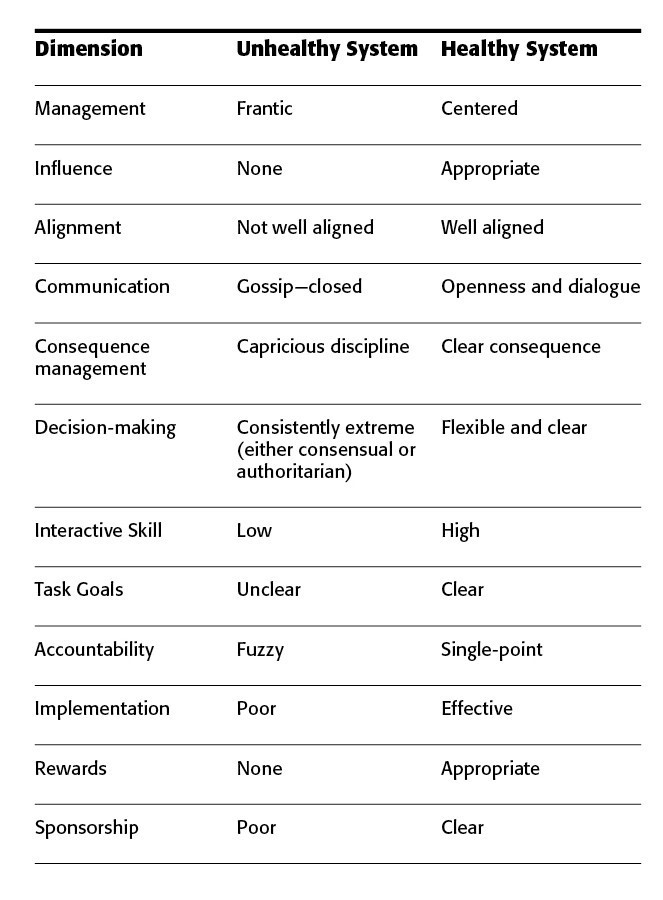
Characteristics of Healthy and Unhealthy Systems

4. Drive Cultural Change through Key Cross-Functional Projects.

A classic example of this occurred during Dr. Crosby’s support at PECO Nuclear as they changed their approach to outages. At the time the industry norm was 90 days to refuel a nuclear plant. Each plant lost somewhere in the vicinity of a million dollars a day in lost revenue. The potential payoff was obvious and huge, but the fear of decreasing the quality of workmanship was understandable and strong. Based on experience in a prior nuclear plant, Dr. Crosby was convinced the issue was organizational and behavioral, not some mythical requirement of a certain length to assure quality. Working with and coaching a hard driving leader, he helped Limerick Generating Station organize their outage cross-functionally, and instil the behaviors, including basics such as working to and adhering to a clear timeline, resulting in a more organized effort. PECO’s leadership seized the model, and set a string of record length short outages coupled with equally unprecedented problem free operating runs.

In Dr. Crosby’s model (influenced by his early years as a community organizer) change doesn’t come if the effort is limited to trainings (although training can support change). Crosby helped change the organization by implementing desired behaviors in the context of key initiatives. Outage execution, for example, is an excellent time to reinforce single point accountability, conservative decision making, conflict resolution skills, surfacing of issues, and related behaviors. The organization becomes the classroom, with each layer responsible for continuous improvement by rapidly surfacing issues (such as the possibility of missing a deadline), and by giving and receiving behavioral feedback.
Such efforts include participative large group planning processes with a cross-section of the organization including the hourly workforce. Again, Dr. Crosby’s methods build the larger team while focusing on a business critical task. His blend of community organizing and organizational development improves the quality of the output (planning that includes the people who execute the plan is almost guaranteed to be a better product), increasing ownership, immediate word-of-mouth communication, and most importantly, successful implementation. The same methods have been applied to many organizations outside the industry, in pursuit of key goals such as increased capacity, or reduced costs, with reliable results.

5. Create a “cadre” of key line people early in the process who can help facilitate the change.

Cadre played a key role at PECO Nuclear, assisting in the change process, decreasing the organization’s reliance on external resources, and continuing to develop the organization from within. These people, recruited from the hourly as well as the management ranks, were equipped with above all else high interactive skills fostered through the Conflict Management workshops and additional training. Aside from their role in facilitating change, many cadre members rose through the ranks in the organization, including the Nuclear Group President (at the time this was written).

At Peach Bottom, they were woven into every initiative, and provided the following on a formal and informal basis:

• Individual coaching regarding conflict, communication skills, etc.
• Third party conflict resolution
• Meeting design and/or facilitation
• Survey feedback and NRR facilitation

Conclusion

In short, the transformation of PECO Nuclear was no fluke. Many variables came together, including great personnel and a unique burning platform (the shutdown by the NRC). Nonetheless, the organizational development approach described above was a best practice and critical enabler, transforming the organization from a rigid and de-motivating hierarchy to an empowered culture built on a clear and thoughtful balance between management authority and employee influence. The same methods are reliable and reproducible, and continue to be implemented in nuclear and non-nuclear organizations to this day.

Partial List of Results from Crosby & Associates Interventions

Peach Bottom Atomic Power Station and PECO Nuclear following NRC shutdown (1987-2001): From worst to first by most industry standards, such as SALP and INPO ratings.

City of Spokane (1985-1986): Broke deadlock on future of Expo 74 site through facilitated citizen’s participation process.

Jamalco (1999-2010): Bottom of cash curve, 1999, top of cash curve, 2005. Reduction of $38 million in annual operating costs. Only refinery on the Island of Jamaica to maintain full production throughout the 2009-2010 Recession.

Grottoes (2005): The estimated annual savings is between $500,000 to $1 million dollars, despite turnover of both the Plant Manger and the Production Manager during the intervention.

AFP Commercial (2004): 4 1/2 % increase in mature market. 40 to 42 1/2 million increase.

CSI Alcoa Oracle Implementation: On time on budget multi-site international Go-Live.

Bohai China Expansion Project (2004): Exceeded target of reducing project costs by multi-million dollar figure.

Baden Aluminum: $5,500,000 reduction in annual operating costs.

Massena: West Smelter – nearly 3 million reduction in annual operating costs and East Smelter (both in 2001) – $6,300,000 reduction in annual operating costs.

Warrick Aluminum (2001): $4,000,000 gain for the year plus additional revenue for the plant because of the central role of the Roll Coats Unit. Intangible Results: The union made a decision to participate in cooperative work with the rest of the plant.

Sherwin Aluminum (2008-2010): Overcame deep conflict through joint Management-Labor experiential learning processes. Sherwin controlled costs and continued production throughout the 2009-2010 Recession while many similar operations went out of business.

Los Alamos: In a multi-billion dollar project for the Department of Energy, Dr. Crosby consulted with Los Alamos National Laboratories and, according to the project director, “…helped to establish a single point of accountability and to develop open lines of communication within the organization. Crosby’s techniques helped to identify and resolve many ‘stuck’ decision-making points.”

References

[1] R.P. Crosby, “Culture Change” (formerly published as “The Authentic Leader”), Crosby & Associates Publishing, 2011, Seattle.
[2] D. Goleman “Working with Emotional Intelligence,” Bantam Dell, 1998, New York.
[3] R.P. Crosby, “Solving the Cross-Work Puzzle,” LIOS Publishing, 1994, Bellevue.
[4] R.P. Crosby, “Solving the Cross-Work Puzzle,” LIOS Publishing, 1994, Bellevue.
Posted in Change Management, Culture Change, Emotional Intelligence, Leadership, Organization Development | Tagged , , , , , , , , , , , , | 1 Comment

Leadership Development – Robert P. Crosby EQ in the Workplace Workshop – June 23rd-27th 2014

“Tough Stuff” EQ in the Workplace Workshops are intensive Applied Behavioral Science trainings which combine cutting edge knowledge about leadership and human behavior with powerful personal insights and skill building. Lead Faculty Robert P. Crosby, 85 years young, developed Tough Stuff out of his experience with T-groups, beginning back in the 1950s. Don’t miss this opportunity to learn from one of the seminal forces in organizational and leadership development.

Participants will increase their emotional intelligence, including how to effectively give and receive feedback, within a framework of individual, group, and organizational theory. The primary goal of the program is to help individuals from all organizational levels and walks of life acquire the strong set of interpersonal skills, solid theoretical perspective, and deep self- awareness necessary to lead and manage effectively.

Participants learn practical skills they can use immediately at home and within their working environment:

• A core framework of individual, group, and organizational theories
• A more objective and scientific self-awareness, rooted in emotional intelligence
• Understanding how, on a life long basis, to learn more effectively from their experiences
• Conflict resolution
• Coaching and developing others
• Change management and Systems Thinking

Join us in beautiful Seattle for what many describe as a life and career changing experience! The next Tough Stuff runs June 23rd -27th, 2013. Tuition is $1250. Space is limited so contact us at c_p_crosby@yahoo.com or 206 369 9200, and sign up today!

Posted in Leadership, T-Groups | Tagged , , , | Leave a comment

Leadership and Human Systems – How Authority Relationships Influence Behavior

Image

Edwin Friedman

This is an expansion of an earlier post: A colleague in the nuclear industry recently asked my opinion of the role “boss stress” plays in nuclear safety culture. Research (study after study indicates that the boss-subordinate relationship is the biggest variable in job satisfaction, turnover, etc.), experience, and common sense all indicate that authority relationships are one of if not the biggest variables in any human system. Yet authority dynamics are poorly understood, and almost randomly executed. An excellent and practical model of the systemic impact of authority relations is the 5 behavioral characteristics of “chronically anxious systems” detailed by systems thinking pioneer Edwin Friedman. He noted the following predictable behavioral symptoms in any organization where the leaders are more a source of unnecessary stress than they are a source of calm focused effort. Each and all result in poor performance:

Reactivity – People go into fight and flight reactions such as keeping their mouth shut, talking behind people’s backs, forming and holding negative judgments and believing them to be objective, etc (read my book, Fight, Flight, Freeze!). The result is unresolved needless drama, an over-abundance of career damaging negative evaluations, and high turnover.

Herding – People over-identify with their own groups (us vs them) and are more concerned about their rights than their responsibilities. Focus is on “how can they treat me/us this way,” “they just don’t understand,” “if they were different everything would fine around here,’ and the result is poor alignment, miscommunication, and defensiveness. These behaviors, along with the next characteristic, kill the upward and lateral communication essential to safety and high performance.

Displaced Blame – People point in every other direction rather than calmly looking at their own role in what has gone wrong/what could make it better. Feedback, when it happens, tends to be negative and is likely to defensively ignored.

Quick Fix Mentality – This is an epidemic. Symptoms include trying to implement too many solutions at the same time, poor implementation, always looking for the next best thing because past efforts have failed to produce the intended results. The root cause (i.e., “quick fix mentality”) tends to be overlooked and defended as a “sense of urgency,” and the people and failed solutions tend to be blamed instead.

Absence of Non-Anxious Leadership – This is the ultimate root cause of all of the above and it replicates itself in a dysfunctional system.

Friedman’s model of non-anxious leadership was the focus of our newsletter, Human Factors issue 9.2, “The Leadership Paradox – the Shared Traits of Patton and Gandhi,” some of which bears repeating here. Both leaders embodied the second characteristic of self-differentiated leadership, as defined by Freidman, The Capacity and the Willingness of the Leader to Take Non-Reactive, Clearly Conceived, and Clearly Defined Positions.

Yes, when you take a clear stand you will almost certainly face conflict from one quarter or the other. Better men than I, such as Patton and Gandhi, certainly did. But those who try to avoid conflict by avoiding clarity, or by agreeing with everyone, are doomed to mediocrity. They cannot lead. “Followers” cannot channel their energy without clarity about where they are heading. As John Dewey put it, “There is no freedom without structure.” Calm clear direction adds essential structure to human systems.

Freidman’s “first and foremost characteristic” of a self-differentiated leader is equally vital. The Leader Must Stay in Touch. As another self-differentiated leader, General William Tecumseh Sherman, put it “no man can properly command an army from the rear.” The belief that “empowerment” and “systems” can create reliable results allowing a leader to sit in their office or attend meetings all day is a false hope. To lead one must fight the shackles of their computer and the meeting room and get out on the floor. To lead you must engage and learn. When you lose touch, you stop leading.

Many in positions of leadership struggle to meet this characteristic. Some are concerned that they will dis-empower the layers of management below them if they “skip layers.” Indeed, empowering middle management and front-line supervision is well worth your attention. But it doesn’t happen through absence. It happens through clear goals and behavioral expectations (such as expecting everyone to constantly be clarifying who will decide what, and by when, and expecting everyone to surface issues/create an open flow of communication), through hands-on reinforcement of those expectations, and by staying in touch without assuming authority that belongs at another level. It’s leaders that “take over” that dis-empower, not leaders that stay in touch.

Insist that others, at all levels, do the same. Don’t get caught in the trap of listening to different parts of the system complain about and blame others. Point them towards the others, ask if they want help, and if not, insist that they let you know about how it went.

In other words, “walk the talk.” Or as Gandhi put it, “Be the change you want to see in the world.” Clarify your expectations, and then live them through your interactions with the organization. Encourage your subordinates to do the same, including letting you know if you seem to be contradicting your own expectations. Encourage surfacing issues, even if, and especially if, they have “issues” with your positions or behavior. Learn to reinforce the behavior of speaking up without limiting yourself to either rejecting or acquiescing passively to what is said. Make sure you understand. If you manage to truly understand what people are telling you, you’ll be in the best position to decide what to do.

That brings us to Friedman’s third and final characteristic of Self-Differentiated Leadership, The Capacity to Deal with Resistance. Resistance is an element of human systems. In families, the members predictably focus their attention on the “black sheep” of the system. In organizations, and each work group, it is easy to do the same. When leaders get hooked on trying to convert or manage the most difficult members of their system, they actually reinforce the status of and tension with that member. Energy is drained from all. The likelihood of an impasse or ugly divorce is far higher than the likelihood of converting the resistance into true support. Yet most leaders get hooked like a moth to a flame.

Like Patton and Gandhi, the path forward is to walk the talk of the first two characteristics. Be clear about what you stand for, stay in touch with all parties, and move forward. This may not break the resistance, but it won’t allow resistance to bog you down.

This is not to say that the sources of resistance are “the problem.” Some people are simply inclined to be the vocal minority, brave enough to be overt in their discontent (search their comments for solvable problems, and let them help you solve them!). Others, of course, will whole heartedly follow you. The majority will probably “wait and see.” Insist that everyone surface issues and tackle barriers! Create opportunities and structure for engagement! The real problem is not resistance. The real problem is if you fuel resistance by becoming obsessed with it.

In sum, there is such a thing as good stress and bad stress. Good stress drives us to perform. Too much stress drives performance downwards. Solving problems, making improvements, delivering safely, on time, and with high quality is challenging enough. Leadership is the biggest variable in keeping the right focus, or in adding needless drama and thus fueling the 5 characteristics. As Freidman puts it, leaders are either a step up transformer of bad stress, or they act as a step down transformer, thus decreasing drama and helping the organization stay calmly and persistently focused on the task at hand.

Take clear stands, stay connected, decrease needless drama. These are the essential EQ skills we drive to a deep level in our experiential Tough Stuff learning process. Join us for the next session. Foster self-differentiated leadership throughout your system and watch performance improve exponentially.

Posted in Leadership | Tagged , , , , , , , | Leave a comment

A future of Organization Development (OD)

Despite the ancient wisdom, “there is nothing new under the sun,” many OD practitioners and their customers seem to be addicted to finding what is “new.” This habit has been manifested over the past few decades through a constant stream of fads such as “change management,” “leaderless teams,” “servant leadership,” “matrixed organizations,” “self-organizing systems,” etc. The list is presumably endless as old beliefs (such as “hierarchy is bad”) and old practices (such as managing change) get repackaged as the latest and greatest. In contrast, a solid future of OD lies in the past. Group learning and action research (also a form of group learning) are theoretically sound and if properly managed will be relevant throughout the ages.

We need look no further than the father of OD, Kurt Lewin, for the elements of this sound approach. He was a systems thinker and a keen student of change. Whether working to change the food preparation habits of US housewives during WWII, the irrigation habits of famers in the dustbowl era, or inter-racial relations in Connecticut, Lewin got carefully documented results by engaging groups in a process of analysis and action. He also recognized the role of authority in systems, realizing in his research on boys groups that his own cadre of group leaders were more often than not ill equipped to lead in a consultative manner…they knew how to lead autocratically and passively, but when instructed to be in charge yet engage the group many of his leaders accidentally became passive.

While incorporating many other sources (most notably John Wallen, Daryl Conner, Daniel Goleman, and family systems theorists Murray Bowen and Edwin Friedman) my father (Robert P Crosby) and now my brother and I (and a small band of colleagues) continue a strongly Lewinian practice, including measuring results through various means (especially through the metrics of the customer). At the core is the engagement of groups, both large and small, in action research, and attention to authority relationships in systems. Both are accelerated through the use of T-groups to increase both EQ and systems thinking. Structure in this way of thinking, is not the problem. There is ambiguity in any structure. As my father puts it (based on ancient sources, of unknown origin), “there is no freedom without structure.” The challenge is for the members of any structure to create as much clarity as possible, including who decides what (and by-when), so that as much energy as possible can be directed towards achieving the organization’s goals. This requires EQ spread throughout the system, so that people take responsibility for co-creating what is not working, and for doing their own mini-action research to continuously improve.

That’s my 2 cents for now. I say “A future of OD” because I’m confident that OD will continue to have many paths. Some of those paths, alas, will be slick marketing without lasting substance, while some will continue to be a catalyst for high performance and lasting change.

Posted in Organization Development | Tagged , , , , , , , , , , , , , | Leave a comment

Sponsor, Agent, Target (SAT) – A Systems Approach to Everyday Work Life

This post, co-authored by Gil and Chris Crosby, is based on founder and father Robert P. Crosby’s adaptation of Daryl R. Conner’s change model.

In today’s organization, most people work with and depend on individuals outside of their immediate work group. Although commonplace, such “cross-functional” work is often poorly understood, resulting in conflict, wasted time, and failed effort. Sponsor, Agent, Target theory, originally conceived as a navigation system for guiding change, provides a roadmap for improving cross-functional effectiveness.

Picture a diagram of a simple org chart, in which Bob and Jill report to John, the Manager of Department A, and Cindy and Jeff report to Mary, the Manager of Department B. Imagine that John asks Bob (the “Agent”) to complete a task that requires working with Mary’s employees, Cindy and Jeff (the “Targets”). If everyone involved does their piece of the task, then there is no problem, and barring complications beyond their immediate influence (budget cuts, etc.), the task will go smoothly.

However, if Bob is not able to get the effort he needs from Mary’s employees (getting “resistance”), then thinking in terms of Sponsor/Agent/Target can be very useful. SAT helps sort out the “systemic” aspects of the problem (how the organization is working or not working) as opposed to focusing primarily on individual behavior (whether Bob, Cindy, or Jeff lack “people skills”). Bob, for example, will have a hard time being successful if Mary has not been told by her boss (or in this case, at least told by John) about the task and Bob’s role in it. If her superiors aren’t in the loop, or don’t really care about the task, then even if she is “informed” she is likely to be (and probably should be) focusing her group on other priorities.

These are the circumstances that “agents” often face. Bob may be great at interacting with Mary’s employees, and he may even go to great lengths to “make it happen” by taking on some of their responsibility, and still accomplish nothing besides getting tired, frustrated, or possibly sick. If Mary doesn’t want her employees to work on the task that Bob has been asked to work on, there is a lack of alignment in the system, and Bob, as well as the task, have not been set up for success.

That is what we mean here by a “systemic” issue. If the front end of your car is misaligned, does it make sense to blame your tire when it begins to wear? Yet that is often what happens in the work place: the “parts” (in this case Bob, Cindy, Jeff and their bosses) eventually are blamed and start blaming each other. Once things have dragged on long enough to attract attention, many organizations will try swapping out the parts without aligning the front end, and the process of “wear” begins again.

In contrast, if the system was working, Mary would already understand that the task is a priority (or would have pushed back at the right level) before Bob has even approached her group. Mary and her employees would then be likely to view Bob as a welcomed resource instead of a nuisance.

If this is not the case, and it often is not, Bob faces a fundamental choice. The first option, often perceived as the easiest, is the uphill, annoying, and frustrating battle of trying to persuade Mary’s employees to accomplish the task. Employees in Bob’s role often continue on this path for weeks, months, and sometimes even years. The second, perhaps initially seen as the tougher or less comfortable option, is that Bob could work to create the conditions that will help him be successful. He can encourage “sponsorship” by asking his boss to build an alliance with Mary about this work, or by going directly to Mary to ask her support of what he is doing. If he goes directly to Mary and she is not supportive of the work, then he needs to go back to his boss with the clarifying message: “there must be some mistake, Mary doesn’t want me to do that work.” If, on the other hand, Mary is supportive, then she can sponsor the work with her employees in a way that nobody else possibly can.

Sponsor, champion, change leader, or whatever you wish to call it, are terms loosely used and frequently misunderstood. John may have great ideas, or more likely be given responsibility to implement somebody else’s idea, and send his employee, Bob, over to Mary’s crew to turn those ideas into action, but he is not a true “sponsor” of Mary’s crew. You can only effectively sponsor people who report directly to you.

That may seem like a surprising statement. After all, organizations often implement large scale changes led by the highest person at a site, or a corporate officer, or the CEO. The trouble is, the farther removed from the targets, the less influence the person initiating the change really has. This is especially true if they are attempting to lead across work boundaries outside their chain of command (such as in the oft repeated mistake of an IT or HR manager trying to “sponsor” work in production). When a leader, no matter how high in the organization, attempts to lead initiatives across boundaries, they’re really no better off than any other agent, prone to all the barriers faced by Bob. When this happens the leader must do the up front work of seeking a sponsor at the top of the target organization, or pay later.

In other words, projects sponsored by a single individual, directly in the chain above all the effected groups, have a huge advantage. Even then, the leader faces the challenge of working through their direct reports to sustain that sponsorship down through the line so that the John and Mary’s of the world are well aligned and able to guide and support their employees.

So SAT is simple. Bob, after taking a reasonable stab at it, insists (politely) that sponsorship and alignment happens at the level where it needs to happen before proceeding with the work. A skilled agent advocates that the system do what it’s supposed to do to set the work up for success. Mary and John, for example, in order to gain alignment, could have a talk and agree on what needs to be done, or seek clarity from higher up if they can’t come to agreement. Mary could then talk with her crew, and Bob, about what she expects of them so that successful work can get done.

Unfortunately it is that simple, yet it isn’t. In the real world, employees may see talking to a boss about getting workers aligned to do work as “ratting” on each other, or may fear that raising the issue up the chain may send the message that they can’t get things done. It may run against values of duking it out with your siblings instead of running to mom or dad. Many employees, at all levels, will default to “proving” themselves by “handling things” themselves (that is, not “bothering” the boss) and will write resistance off as caused by “unchangeable personality conflicts.”

In short, it takes guts and skill to work out these situations. Employees need to recognize and flag alignment issues. When issues do get flagged, managers must focus their effort on building alignment at their level and above, and even let go of proposed work if alignment is not achieved, rather than blaming and “fixing” the people down below. This isn’t to say that there are never individual performance issues: focusing on the individual should be the exception, or at least a parallel path, rather than the standard knee-jerk response.

Simple and complex, Sponsor/Agent/Target is a way of helping sort out problems of alignment when work that crosses boundaries and layers isn’t going well. SAT can be used from any spot in an organizational chart as a way of creating progress when work and initiatives seem stuck.

Posted in Change Management, Systems Thinking | Tagged , , , , , , | Leave a comment

Lean Manufacturing

The key to lean is Action Research. Giving credit to Kurt Lewin, those on the front lines continually assessed the current situation, created actions towards a desired state, implemented, evaluated and recycled the process. Americans frequently ‘bought’ the product at a certain stage of its development and imposed it. The first time a client included me in a Lean training, the current situation was assessed by supervisors WITHOUT the workers! In a current draft of an article I write: Lean manufacturing, which originated in Japan and swept across U.S. plants, is but one example of a process that uses action research as the core implementing activity. Action research is distinct in that it not only involves the people who will be affected by any change (and who often carry out the change) in the analysis of the problems, but also in the identification of possible solutions. So called lean manufacturing in the U.S. is frequently lacking on both counts. Too often, American companies try to impose a solution discovered elsewhere and neglect the action research process through which it was developed, sustained and constantly improved.

There are other downsides to the implementation of lean manufacturing that are not talked about much. Many organizations apply lean thinking to staffing prior to doing the work of having effective lean processes. Also without sharing the gains in terms of increased wages for the remaining employees. This impacts morale and creates a condition at many plants where if a few employees call in sick they literally have to start shutting down operations. The same consequences can come from going too lean on parts and supplies.

Lean principals are great, lean implementation is often a disaster.

Posted in Lean Manufacturing | Tagged , , , , , , , | Leave a comment

The Eight Missing Elements in Project Management

There are eight elements frequently missing in Product Development and Project Management, thus seriously impairing such activities. In fact, most organizations accept as a given that these critical activities will be late and over budget, and will only be salvaged, if at all, through heroic (and horrific) effort. Astonishingly, one study estimated US losses of $81 billion in 1995 on cancelled software projects alone, and that only represents a sample of over-all corporate initiatives (The Standish Group Chaos Report). Fortunately, a more reliable output is probable when the following elements are in place.

The Eight Missing Elements

Single point accountability
Decision making clarity
Employee Involvement in planning & implementation
A Project Manager with strong behavioral skills
Effective Sponsorship & Sustaining Sponsorship
A critical mass with specific behavioral skills
A clear & compelling Business Case
A communication “kick off” and follow-up

1. Applying Single Point Accountability (i.e., one person, not one group) to any task that must be managed during the process. This is especially vital given the matrixed cross departmental and cross organizational nature of modern projects.

2. Clarity about who decides (again, Single Point) and by when.

3. To the extent possible, engage employees impacted by the project in both planning and implementation.

4. A single Project Manager functioning as a change agent (not as a boss except among those who report to her/him), with high ability to be both confrontative in a non-blaming way and empathic, must monitor and manage the work.

5. Sponsorship and Sustaining Sponsorship is essential. Allow me to expand on this poorly understood yet vital element. The employee looks to his/her immediate boss for clarity about daily priorities. The supervisor of any employee is, in reality, their only effective Sponsor. Furthermore, “the manager (supervisor) can only Sponsor those who report to him or her” (Walking the Empowerment Tightrope, King of Prussia, PA 1992, page 21).

The CEO (or whomever is the initiating Sponsor) must build Sustaining Sponsorship with their direct reports, who in turn must build Sustaining Sponsorship at the next layer, and so on down to the level of the floor supervisor. This cascading alignment is often neglected. Worse, many projects attempt “matrixed” Sponsorship (for example, the MIS Director “sponsors” change in production). Such arrangements are the kiss of death.

6. A critical mass of organizational leaders and product/project employees must be capable of giving and receiving specific, non-blaming & timely feedback.

7. It must be clear to all involved why this project is important.

8. Goals, roles, and the timeline must be communicated to all impacted employees via a kickoff and periodic updates.

Skillful application of the above consistently results in key initiatives coming in on time, on budget, while meeting or exceeding customer and quality standards.

Posted in Change Management | Tagged , | 1 Comment

The ERP Puzzle – Key pieces of successful software implementation

Most businesses use some form of an Enterprise Resource Planning (ERP) system. Many have a terrible time during initial implementation or during subsequent upgrades. Despite this, ERP systems are here to stay. ERP systems (such as Oracle, MAS90, and SAP) are the information systems used to take, manufacture, ship, and account for customer orders, as well as to manage finance, purchasing, sales, planning, and inventory. Once you convert to an ERP system, upgrades and transitions to new systems become a fact of life.

Miss-managed implementations can temporarily cripple operations, cause sharp spikes in workload and stress, and negatively impact the bottom line in a manner far greater than the projected project costs. Research, such as the Standish Report on Project Success, indicates that most implementations go poorly. In fact, only 34% finish on time and within budget, while the rest are either abandoned in midstream (15%), or incur cost and schedule overruns or missing functionality (51%).

The ideas below are not a prescription for all implementations but rather a set of critical levers that may apply to your situation. The list only includes items that I think are often missing or done in a haphazard way. As you think about your situation decide which levers to pull in order for your implementation to be as successful as possible.

Obtain support from the top but build support throughout the system – The top leader in your organization must make it clear to everyone that you are implementing a new system and set the expectation that the success or failure is dependent on the whole organization, NOT just the project team.

Set the scope to minimize the impact on the manufacturing floor – Many businesses have multiple systems from different vendors. Each ERP implementation project must choose which old systems get replaced or interfaced into the new system. The process of building appropriate scope should be discussed with key managers with as much clarity as possible as to the risks and benefits to each decision. To the extent possible the manufacturing floor systems should be kept intact unless a clear advantage is shown in replacing the existing systems. If you disrupt the floor, the pain to the customer, and thus to your bottom line, can be immense. The Business Unit I worked for retained our floor system; other BU’s did not and paid a tremendous price for it in the form of missed deliveries and disgruntled employees.

Don’t sell it once it’s bought – Tell the end users with as much clarity as possible what you think they will gain and lose as a result of the software systems. Do not sugarcoat anything. Be honest about how difficult and the amount of work the implementation will require. Most end users have been through system changes before and know that it can be very difficult. If you are upfront with them they will respect you more in the end. On the other hand, if you only point out the great things the system will do while ignoring the constraints, potential problems, and amount of work, you will not only build resistance to the new system but potentially damage your credibility.

Spend time educating the managers above the people who will use the system – The project manager must spend significant time educating key managers on the project. Keep them informed regarding next steps in the time line, project issues, potential problems, key decisions that must be made, and, perhaps most importantly, ongoing resource needs.

Involve the real end users – When configuring the system make sure you involve the people who will do the work, NOT merely a representative. These end users must be your top players and be able to point out any potential issue that will hurt the business. Issues can be solved if raised, but if they are never raised until you start using the system you will be in serious trouble. IT People often say, “Just turn the system on, then we will stabilize it.” Do not listen to this logic; it will cause you way more pain than it’s worth. Instead, pay now and involve the end users in each step of the way. During the implementation above the end users raised over 500 issues through the testing process. We still had a few surprises at “go live,” but imagine how many we would have had if they only raised 50 issues?

Cultivate input – During software configuration the goal is to get as much input as possible. When end users raise issues, listen, paraphrase, and write them down. If you can add a “thanks,” that is even better. The number one factor on how much input you will generate is how you receive it when it starts coming. After you are clear about the issue they raise, then have a predetermined process to determine whether, and/or how, and when it will be solved. That process must be clear to all participants and continue to be taught, refined and clarified as the project progresses.

Clarify what can be changed and what has to be lived with – Another key to input from your end users is to clarify what has to be adopted and what can be adapted. Don’t expect this to be a one time easy conversation. Software systems are complex. The average person will not be able to grasp all the information immediately, and some will push the same issues several times until they really understand it. And well they should, because frequently, when pushed, the project team can create solutions that they didn’t initially envision, and solve problems that they didn’t think they could solve.

The configuration process is a game in which there are several levers that can be pulled, thousands perhaps, and each lever leads to another set of potential solutions and problems. The project team has a full time job to educate the end users helping in the configuration process. This education must be done with patience and grace. The key to good involvement is to set boundaries while rewarding feedback.

Be aware of the trade off between better data for the organization, and more work for end users – Better information does not come free. In all systems anything that you want to obtain at the back end must be input into the system by an end user. In our business the financial people wanted information on the product by piece. A reasonable request, but that information is not used by anyone else in the organization to make better business decisions, and it would have cost an extra man hour per shift to input the data (as determined through a time study). Getting this data would have cost thousands and given very little for the business in return. Make sure you have a decision process in place that helps sort through the validity of asking for additional input and balances that with basic operation needs.

Have the right and enough technical resources – ERP systems are at best well constructed software programs that are robust and flexible. At worst they are poorly written pieces of software that break down more than they operate. Each have series of modules specific to the different business areas such as planning and finance. Many have new modules to meet an ever expanding list of requirements and are filled with bugs and complexities. Expect to spend a lot of money on technical resources to assist with the more complex or newer modules, or to suffer the consequences if you don’t. Slow progress in getting modules up to speed could signal the wrong, or most likely, insufficient technical resources. With technical resources, you truly pay now or pay later.

Create clarity of decision making, especially when it comes to moving from testing to using the system – Most software implementation projects proceed in stages from configuration to testing, and finally “go-live.” At each stage, there should be a decision making process which balances influence from the end users who are helping to configure the system. Including the end users creates a decision matrix between the BU lead team, the local lead team, the end users, and the project team. Do not allow the project team to make decision recommendations to the BU and location lead team without the voice of the end users.

During our implementations, at the end of each stage, end users from each area impacted by the project raised their critical issues to the local lead team. They also indicated if their area was ready to move forward to the next stage or should take a “time-out” and solve critical issues. The local lead team weighed the information in terms of overall impact to the location and made their suggestion to the BU lead team who in turn made the final decision. The project team facilitated the process as well as added their opinions.

The above process caused several things to happen. First, we did not go live on a few occasions as planned. Second, the end users and the location lead team were significantly informed of each issue at risk. Finally, when we did go live the end users were ready and in most cases, were actually lobbying to turn the system on.

Do not skimp on go live support – Most people understand that there is a difference between classroom training and working in a live system. Make sure you have enough support to help anybody with keystroke needs for the first few weeks after go-live, and do not leave until the end users and the internal location person say it’s ok.

Every ERP system, like every business and every location, is different. Each has its own problems that must be solved to achieve an effective implementation. While it would be wise to consistently assess the items above, the need for action will be situational. I have seen software systems implemented where no additional technical expertise was needed, for instance, but I have also seen projects suffer because the right help was obtained only after a delay.

I cannot say this enough: to be most effective, besides choosing the right system, you must plan all facets of your implementation. This guide is intended to help prep and plan your ERP system adventure.

By Chris Crosby

Posted in Change Management | Tagged , , , , | Leave a comment

Self Differentiated Leadership

A self-differentiated leader is able to lead and connect simultaneously. They respect their own inner guidance system – what they want, think, and feel – and convey their sense of direction clearly, calmly, and consistently. They follow their own path, yet respect and tune into the people they are leading. They are self aware, manage conflict with minimal ego and defensiveness, consistently listen and understand the perspectives of others, and encourage openness even in the form of apparent dissent. They take clear stands and hold people to clear standards. They recognize their emotional impact on the organization. They are serious but don’t take themselves too seriously. They have fun, which in turn encourages a playful yet focused emotional energy.

– Based on the work of Edwin Friedman

Posted in Leadership | Tagged , , , , , , , | Leave a comment

T-Group as Cutting Edge Post #5:

Implications for OD Practice

The first major implication from what I have written above is that team and even some leadership development, not just T-group training, needs to be done with intact groups. This minimizes the problem of transfer of learning.

A second major implication is the importance of behavioral description as understood and taught in our unique T-group innovation. Even if the OD practitioner never does a Tgroup with a client (which would be unwise to do without training and apprenticeship), it is our belief that knowing and integrating our strict definition of both behavior description and openness into one’s habitual communication is essential! For instance, if I think that feedback is giving others my judgment of them rather than feedback as stating the specific behaviors that I’ve seen and heard, then I am fused and probably unaware of my emotionality in that moment. My judgments, besides NOT being facts, come from deep within me and are a clue about what lenses I wear looking out from my eyes. They tell the story of me and how I uniquely, emotionally, view the world.

I know of no one who wrote with more clarity about this than John Wallen, (Chinmaya, A., Vargo, J.W.) for me a giant in the field of OD and interpersonal communications.

His precision about communication and his skill exercises permeate all of our books and our work. Like no one else, Wallen emphasized “behavior description.” Without that skill of specificity, feedback is reduced to judgments about the other and to endless blaming. His “Interpersonal Gap” is an interpersonal systems theory that turns communication “upside down,” in that it helps those who comprehend it to realize that:

1. The receiver of the communication, not the giver, holds most of the keys towards resolving any confusion arising in the conversation since it is the receiver who knows if s/he is confused or irritated by an interaction. The sender may or may not sense this.
2. I create my own emotions based on my interpretations of your actions. You don’t
“make me feel…” — I do!
3. My unique interpretations of the other (responding to words, gestures, face, and tone), sometimes leads to my misunderstanding the other. I don’t know the others “by their actions,” but by my interpretation, which is often (especially in tense moments) different from their intentions. Wallen claims that more than 50% of all conflicts come from this gap in understanding.
4. Until I profoundly comprehend this, I will live a lot of my life as a victim pointing my finger elsewhere as I search for answers to repeated communication dilemmas.

Hunching by the observers, related to the behavior listed in the left-hand column, is the door to empathy. Many participants at the beginning of the training list judgments on the left and more judgments on the right. Until they become more emotionally aware they cannot do either the left- or right-hand column with much accuracy.

The practicality of being more precise soon becomes evident to most participants. Without specificity, employees and bosses don’t get what they really want; so-called feedback becomes blaming; goals and roles are fuzzy, and huge waste of time and energy follows.

Integration with Task Work

It is our contention that for OD and T-group training to be effective it must be integrated with the real problems and challenges that are taking place within the location. “Goodwin Watson (1947) warned that the skill training had to accomplish more than ‘the warm glow of participation’ to achieve objective results by truly implementing a databased project cooperatively.” (Schmuck, 2008) The following is an example of how we help each client do so.
During a recent 7-week intensive training (spread out over nine months) with a manufacturing company our firm enhanced an innovation that we have been evolving during the last decade. Each participant had a project that was cross-functional and that was expected to contribute to the bottom-line. The CEO signed off on each one. Work on this was interwoven into the sessions, all of which included continued Skill Group sessions.

For a systemic analysis of each project/task, we use our adaptation of Conner’s work. (Conner, 1992) Especially we insist that you can only sponsor your immediate direct reports. (Crosby, 1992 and 2011) Thus, if a supervisor isn’t aligned with bosses above, the crew almost always follows their immediate supervisor’s lead regardless of what higher-up managers are espousing.

We have each person chart their project or their cross-function task. We use Sponsor, Agent, Target, and Advocate as an analytic tool that helps each person build their strategy to achieve success in the socio-technical aspects of the change they’re attempting. It is not unusual for these to net significant results.

In Mexico recently with a multinational firm, our Tough Stuff had 34 participants (in three groups) from eleven countries. It is a part of a strategy which the top manager (V.P. of Central and South America) has begun putting in place. We have worked with him for
13 years in other companies. He distributes a book (Crosby, 2011) which describes the training and his preferred OD strategy and announces it as a “blueprint” for how he wants his company to be. It is important to highlight that the T-Group is not a standalone intervention!

Thus, Tough Stuff, or any OD intervention, is done in the context of business goals. For instance, when we present decision-making, each attendee will identify decisions that aren’t being made in a timely manner and which person needs to have single-point accountability for each decision. At midweek, the V.P. joins each of the three T-groups in a session that deals with their relationship to him. In it he models what is being taught in the Tough Stuff event. He has been in many of our trainings over the years and is highly skilled. This is sponsorship at its best!

Even in this 5-day training, we have attendees identify cross-functional, day-by-day issues or projects which cross department lines. Our goal is to have them identify conflicts that are delaying effective work. We believe that most so-called interpersonal conflicts are really systems issues stemming from misalignment of bosses higher in the chain-of-command rather than where the conflict appears to be happening.

In this Mexican training, the V.P. took an active part in the formation of six groups whose success he deemed of high importance. This is yet another example of how his sponsorship maximized the relevance of the training event and reduced transfer issues. On the 10-point, anonymous scale about “Applicability to Work”, this international group rated it a median of 9. Some readers may wonder whether this adaptation of the Tgroup to business still impacts the individual’s personal life. Rating the question, “Applicability to life outside work,” the median was also a 9!

Summary

Our unique innovation to T-group is cutting edge because of how we integrate it with business goals and constantly help the participants make direct day to day implications to work. When done in this fashion significant transformations happen like those highlighted at the Davenport Plant visited by President Obama in 2011. In my career, those interventions that tend to be sustained have integrated T-group opportunities as described in our model, for both hourly and salaried employees, into the equation. The EQ maturation, systems understanding, awareness of the distinction between behaviorally descriptive feedback and judgmental pseudo-feedback has direct relevance for the success of the business. Also the movement from victim to proactive creator and their new ability to manage conflict more constructively bodes well for the health of individuals, and companies. These are deeply learned in a T-group. Work on real projects and/or cross-functional dilemmas done in the context of this in-depth experience increases the possibility that the learning will be sustained across the years.

(Contact us for a complete bibliography)

Posted in T-Groups | Tagged , , , , , , , | Comments Off on T-Group as Cutting Edge Post #5: