
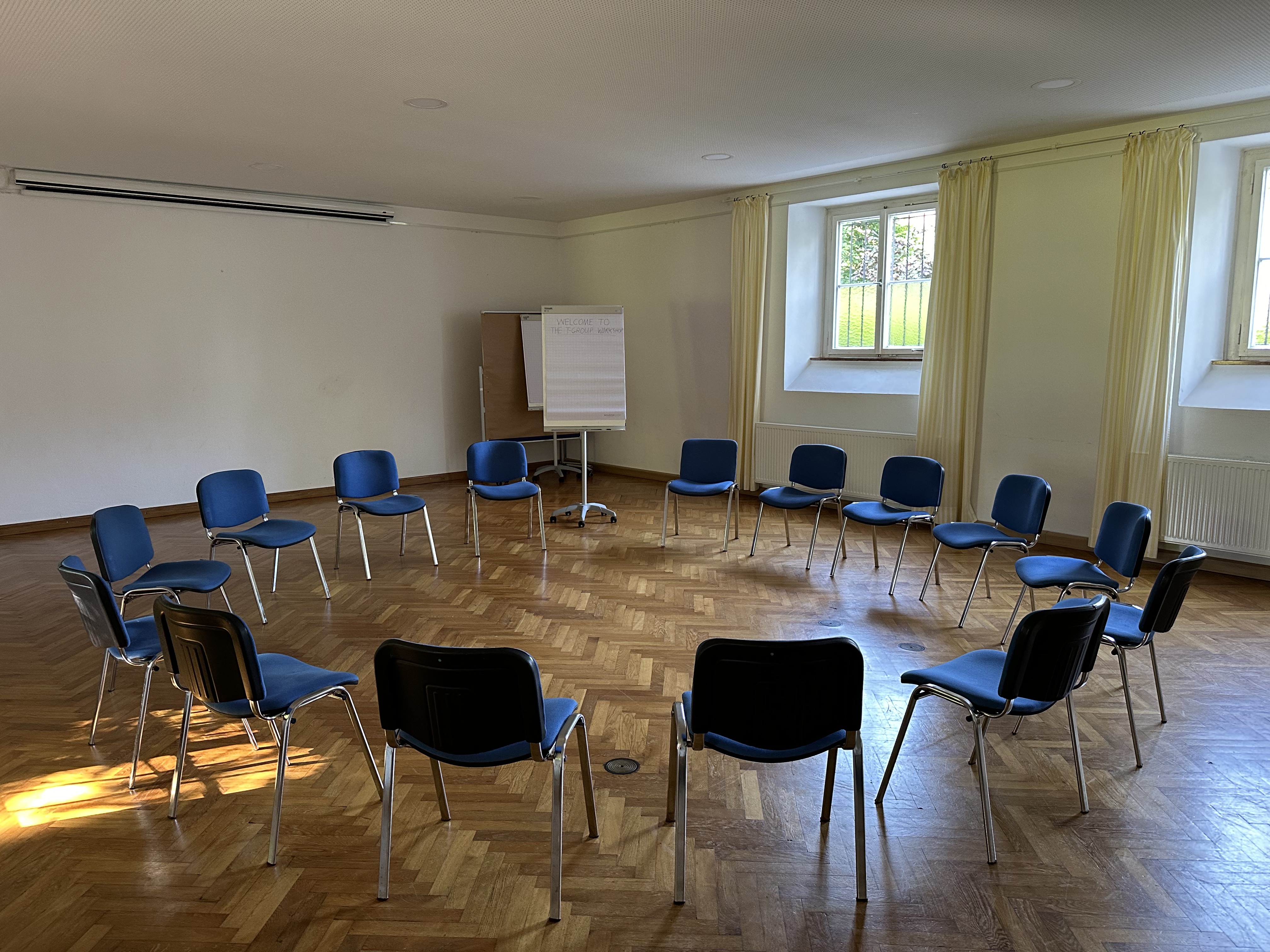
A T-group participant’s experience in their own words
Posted in Emotional Intelligence, Leadership, Lewin, T-Groups
Tagged #LEWIN, OD, Organization Development, T-Groups
Leave a comment
Trouble…Right Here in OD City!
Oh we’ve got trouble!
Right here in OD city!
With a capital T,
that rhymes with C,
that stands for complexity!
Oh we’ve got trouble!
We’ve got terrible terrible trouble!
We’ve got to find a way to make OD relevant despite VUCA!
I’m talking about VUCA, don’t you understand?
That’s Volatility , Uncertainty, Complexity, and Ambiguity (Oh my!)
Today’s problem’s are different don’t you know
You can’t rely on the OD methods of the past
There’s AI
Generations X, Y and Z
And above all else, complexity!
Friend, either you’re closing your eyes to a situation you do not wish to acknowledge Or you are not aware of the caliber of disaster Indicated by the presence of VUCA in the problems faced by contemporary OD
Well, ya got trouble my friend
Right here I say, trouble right in OD City
Why sure, I’m a Lewinian Certainly, mighty proud I say, I’m always mighty proud to say it I consider that the hours I spent studying Lewin and the other founders of OD were golden… Helped you cultivate horse sense and a cool head and a keen eye
Did you ever break and try to create a new cultural homeostasis
By involving the people who do the work and are facing the problems?
But just as I say it takes judgement, brains and maturity to acknowledge VUCA
As the dangerous threat that it is
I say that any fool
Can grab a flipchart and ask a work team to analyze their own problems and come up with their own solutions
And I call that reckless
The first big step on the road to disaster
I say, first, catching fish with help, and then catching their own fish, with out recognizing the tsunami they are in
… And the next thing you know your customers are trying to do their own thinking
And solve their own intergroup problems
Without understanding the desperate situation that VUCA represents
And that is why we need new models
So we can save them from themselves
And teach the next generation of OD professionals
And get that sales boost and thrill that comes with new
Lewin was fine in his day and age and all that but…
Like to see some cocky worker implementing their own solutions? Make your blood boil
Well I should say
Now friends, let me tell you what I mean
You got V, U, C, A,
Four different ways that the sky is falling
All packaged together and operating in one big scary acronym!
Ways that mark the difference between an expert and a rube With a capital “R” and that almost rhymes with “C” and that stands for complexity!
Now listen folks
I know you are the right kind of OD professionals
The kind that doesn’t make waves with the current direction of the field
If we don’t come up with new OD and new interpretations of the old
Here’s what’s gonna happen
All week long your OD City professionals will be fritterin’ away I say, your professionals will be fritterin’
Fritterin’ away their noontime, suppertime, choretime too
Doing Lewinian stuff such as
Working on the customer’s goals, involving the people who are facing the problems, and transferring skills
Never mind gettin’ expert analysis done
Never mind changing the structure
Never mind flattening the organization, getting rid of supervisors or changing their names
…because as everyone knows hierarchy is out of style old-fashioned trouble (trouble, trouble, trouble)
Never mind taking a survey and being the expert that tells everyone what it means and what to do
Or talking to management for the employees instead of helping them talk directly to each other
Or starting change wherever it emerges without alignment in the system
Never mind many of the trends of “new” OD
And that’s trouble
You got trouble, folks, right here in OD City,
trouble with a capital “T” And that rhymes with “C” and that stands for complexity!
… Trouble (oh, we got trouble) Right here in OD City (right here in OD City) With a capital “T” and that rhymes with “C” and that stands for complexity (that stands for complexity) We’ve surely got trouble (we’ve surely got trouble) Right here in OD City (right here) Gotta figure out a way to keep the young OD professionals enraptured after school (We gonna have trouble, trouble, trouble, trouble)… OD professionals, heed this warning before it’s too late Watch for the tell-tale signs of complexity Do you live in an age with new technology?
Did your customers go through a pandemic?
Are they trying to figure out hybrid work?
Are some of their employees from generation Z (trouble, trouble, trouble)
Do they meet on-line and from remote locations?
Is their workforce diverse?
Are certain words creeping into their conversation Words like, like “sus”? (Trouble, trouble, trouble) And “resonates’? (Trouble, trouble, trouble)
And “agency”? (Trouble, trouble, trouble)
… Well if so, my friends, you got trouble (oh we got trouble) Right here in OD City (right here in OD City) With a capital “T” and that rhymes with “C” and that stands for complexity (that stands for complexity) We’ve surely got trouble (we’ve surely got trouble) Right here in OD City (right here) Remember Volatility , Uncertainty, Complexity, and Ambiguity! (We’re gonna have trouble, trouble, trouble, trouble)… Oh, we got trouble, we’re in terrible, terrible trouble Addressing contemporary problems with old solutions is the devil’s tool (devil’s tool)
To believe Lewin’s old methods apply today you must be a fool! Oh, yes we got trouble, trouble, trouble (Oh yes we got trouble here, we got big, big trouble) With a “T” (with a capital “T”) Gotta rhyme it with “C” (gotta rhyme with “C”) And that stands for complexity (that stands for complexity)!
Adapted with great respect from “Ya Got Trouble” by Meredith Willson, a song from the Music Man, in case you don’t know. Disclaimer: My blog posts mostly explore leadership, change, and topics relevant to the general population. This one is satire directed at a tendency in the OD profession to hypothesis (without any real research) that the world is significantly different “today” for many reasons, “complexity” being a favorite claim, and thus solutions must be new fangled as well. I don’t buy it. If you know me you know I apply Kurt Lewin’s social science (even though it is new…less than a century old lol) for the practical reason that it is the most universally reliable method of individual, organizational, and social change that I am aware of, and I have explored many approaches, integrating some into my methods, and discarding others (even if they are popular). I am in conflict with much of the OD profession regarding these matters, and that is disappointing but ok.The Group is the Thing…in Leadership Coaching and Development.
Coaching has become an enormous industry. Almost all coaching occurs in one on one conversations. Out hypothesis, based on more than a combined century of work, is that development of leadership skills and habits best occurs in the context of the leader’s systemic relationships. Coaching that only occurs separate from actual work relationships are more prone to people who need help the most gaming the development system. Our process includes coaching the participant while they interact with their direct reports, the application of learning by the participate to a real work case study, facilitated one on ones between the student and their immediate supervisor, lots of T-group based experiential learning, and live feedback between the student and their peers throughout the course. If you only see a student privately and/or in a traditional class room setting they may be good talking the talk but weak at walking the walk back in the work system, which is where it really matters.
Posted in Uncategorized
Leave a comment
Kids These Days – Retaining Generation Z
I wrote this in response to a post on LinkedIn about a 25 page report explaining how to retain young people. While times of course are changing I cant help but notice during my 64 years on this planet that adults throughout my lifetime have been lamenting the declining work ethic and morals of each next generation. This lament has been turned to a quasi-science in recent years, with experts studying and consulting on how to manage generation Z.
The answer my friend is blowing in the leadership model of Kurt Lewin (and the wind). The leader must provide enough structure (“Here’s what we are trying to accomplish,” “Here’s what I am looking for from you,”) and enough freedom (“What do you think we need to do?” “How would you do it?”). The right balance of freedom and structure will vary with each person and each situation. The leader and the employee might differ some on the right blend, and honest dialogue is the only way to work through the discomfort that is inevitable in a reporting relationship. For example, if I am mentoring you in doing OD, I may think you need more direct oversight than you think you need. That doesn’t mean that the tension is automatically bad and too be avoided. It’s inherent in any authority relationship. Both leader and employee would be wise to also do family of origin exploration of their reactions to and beliefs about authority. Since the reporting relationship in many ways recreates a parent-child relationship, it would be wise to do that work together. The less unconsciously reactive we are the more we can make reporting structures work. There are many ways to learn about conflict and reactivity, and to get better at owning one’s own reactions and more calmly working out differences. These are skills essential in any job and at any age.
Back to my response to the LinkedIn post: Too much leadership/structure stifles employees, too little creates chaos. The same is true (in reverse) of freedom. Too much freedom creates chaos, too little stifles employees. Find the right balance with each person and you will foster higher productivity and morale regardless of age. This requires thinking out loud with each other, and establishing mutual respect. You do that effectively and most people of any generation will respond to your leadership.
Posted in Generation Gap, Gilmore Crosby, Lewin
Tagged Authority, generationz, Leadership
Leave a comment
The 12 ODs of Christmas
12 podcasts casting, 11 fields unfreezing, 10 groups brainstorming, 9 Lewinians leaping, 8 groups a forming, 7 groups a storming, 6 groups a norming, 5 groups performing, 4 measurable goals, 3 OD professionals screwing in a lightbulb, 2 leaders self-differentiating, and an increase in morale and productivity! Happy Holidays!
Podcast #12! https://ascienceofchange.libsyn.com/a-conversation-with-kurt-lewins-grandson-michael-papanek
Posted in Lewin, Organization Development
Tagged Gil Crosby, Organization Development
Leave a comment
Lewin in a Nutshell: A Scientific Method of Change
My latest podcast! Everything you need to know about change! https://ascienceofchange.libsyn.com/lewin-in-a-nutshell-a-scientific-method-of-change
Posted in Change, Leadership, Lewin, Organization Development
Tagged Leadership, OD, Organization Development
Leave a comment
In Defense of Defensiveness
An excerpt from Spiritualty and Emotional Intelligence, 2021, by Gilmore Crosby
…Defensiveness has been so demonized in the modern corporation that most people put a lot of effort
into trying to pretend they are not feeling or being defensive, and “You’re being defensive” has become an easy way to attack someone else. Now they are trapped. If they deny or defend you have them right where you want them, like a bug squirming and thrashing as you pin them to your
collection.
This aspect of corporate culture may relieve some boredom, but it is obviously destructive. It’s far better to admit to oneself if one is feeling defensive. If so, one must perceive whatever is happening as an attack or danger of some sort. If one is aware one can then chose to:
A. Question their own perception
B. Check with the other to see if they have misunderstood the other
C. Defend
D. Do something else in the almost infinite range of possibilities.
Wallen’s aforementioned behavioral skills (see the blog post: The Interpersonal Gap Part One) help to decrease misunderstanding and hence defensiveness, and also help to deescalate defensiveness when it does happen.
Take note of option C. Defending is neither good nor bad. At times it is absolutely wise to do so. On the other hand, if one is defensive and unaware they will defend habitually. Again, that is a tiresome experience for self and other. It is certainly not likely to be mutually satisfactory. I used to do it all the time in my teens and early adulthood. I could wear my perceived attackers down with (biased) logic until they gave up and somehow got out of the conversation. If they told me I was being defensive I would defend, often by attacking (that’s the best defense, right?), until they gave up.
It took repeated feedback for me to get it into my thick head that I indeed had a habit of defending. Then I had to learn to notice when I got tense, and to question my cognitive processes. Instead of trying to “mess with me” or “control me” maybe, for example, people were asking questions because they were genuinely trying to understand. That cognitive shift led down an entirely different emotional path, much preferred by self and other. I began to get it that there was a better way. I learned that if someone was upset with me, that if I genuinely tried to help them get behaviorally specific about what I said or did, that the act of trying to understand calmed both of us and often either taught me a lesson about my impact or, more often than not, cleared up misunderstandings about what I had done or said. I’m not always aware even today, with decades of working on it, but I am likely to notice sooner instead of later if I am feeling and behaving defensively, and as soon as I notice I can calm myself and make choices about what to do. That could include explaining something (defending) if I think I have good reason to believe I understand what the other is saying and I think there is something important they are unaware of. It could also include admitting to the other that I am feeling defensive. On the other hand, I feel defensive a lot less than I used to, and I am pretty sure it is not because the rest of the world has changed. I used to get defensive about stuff that wasn’t intended the way I took it, and I have also learned that even if someone is “attacking me” I don’t have to take it personally. I don’t want to carelessly disregard other people, but I definitely don’t want to swallow their issues whole.
So be kind to yourself when you feel defensive and at least admit it to yourself. Otherwise, you will almost certainly be a prisoner of a pattern of defending. Likewise, be kind to others when they are defending. They must think they have been misunderstood or criticized in some way. Take a deep breath (in through your nose and into your belly) (take several deep breaths) and find out what they think is happening. If you think you understood what they are trying to say, paraphrase. If you got their message the way they intended but they don’t know it, they are likely to keep repeating the message over and over with slight variation in the words. That is a clue that someone doesn’t think they have been understood and may be feeling defensive (or whatever other word you want to put to the increase in emotional intensity— likely a red word). People do that when they are trying to convey something and they aren’t getting an effective response. Break the pattern and help others do the same. Don’t demonize defensiveness. It’s a clue about what is happening. Use the clue to activate your awareness so you can change what is happening as constructively as possible. And for heaven’s sake, if everyone is defending and denying in your organization stop blaming the people and figure out what to do about it. Change the culture. It doesn’t have to be that way.
Posted in Emotional Intelligence, Gilmore Crosby, Leadership
Tagged Emotional Intelligence, EQ, Leadership
Leave a comment
Diversity without Dogma – Quotes leading into the book
As part of an upcoming podcast, I just revisited…and continue learning from…the quotes leading into my latest book, Diversity without Dogma:
“The burden of being black and the burden of being white is so heavy that
it is rare in our society to experience oneself as a human being. It may
be, I don’t know, that to experience oneself as a human being is one with
experiencing one’s fellows as human beings. It means that the individual
must have a sense of kinship to life that transcends and goes beyond the
immediate kinship of family or the organic kinship that binds him (or her)
ethnically or ‘racially’ or nationally. He has a sense of being an essential
part of the structural relationship that exists between him and all other
men (and women), and between him, all other men (and women), and the
total external environment. As a human being, then, he belongs to life and
the whole kingdom of life that includes all that lives and perhaps, also, all
that has ever lived. In other words, he sees himself as part of a continuing,
breathing, living existence. To be a human being, then, is to be essentially
alive in a living world.”
Howard Thurman (1965, p. 94)
“When you plant lettuce, if it does not grow well, you don’t blame the lettuce. You look into the reasons it is not doing well. It may need fertilizer, or more water, or less sun. You never blame the lettuce. Yet if we have problems with our friends or our family, we blame the other person. But if we know how to take care of them, they will grow well, like lettuce. Blaming
has no positive effect at all, nor does trying to persuade using reason and
arguments. That is my experience. No blame, no reasoning, no argument,
just understanding. If you understand, and you show that you understand,
you can love, and the situation will change.”
Thich Nhat Hanh (Hahn, 1991, p. 78)
“Anytime you have an opportunity to make a difference in this world and
you don’t, then you are wasting your time on earth.”
Roberto Clemente
“Where do we go from here? Chaos or community?”
Martin Luther King, Jr.
“United we stand, divided we fall.”
Aesop
On-Line (and In-Person) Meeting Dynamics
The post-pandemic world is awash with hybrid and remote work, and the use of virtual meetings. There is nothing inherently wrong with that, but just as is true of in person interaction, quality is up to us. The following are tips on getting the most out of your on-line interactions (many of which apply in person as well).
Don’t under-communicate. This is a plague in most organizations. The people that depend on you are the best source of feedback on whether they are getting the information they believe they need in order to get their jobs done.
Feedback. Ask for it regularly about whether the meeting is still necessary, whether there are ways to improve the format, etc.
Don’t over-communicate. Don’t meet so often that it becomes an obstacle to productivity instead of a asset.
Create an agenda and follow it. Review it at the beginning of the meeting and ask if there is anything that is urgently in need of being added. Tackle the most urgent and important items first in case you run short on time.
Time. Be impeccable about time. People will adjust to the norm you set. Start late, they’ll show up late. Start and end on time!
What, who, by-when. Check to see whether there are actions that need to occur (and who is going to do them and by-when) after each important discussion. Track in a manner that can be visual for all (on a white board or on a doc that can be shared, etc.) and distribute at the end. At a minimum, review commitments from the last meeting that are slipping (“Of the commitments made last meeting, are any slipping?” Important accomplishments should also be mentioned, so others are aware.
Be efficient. Stay on track. Request conversations that can really be handled by two or a small sub-group be tabled and recommenced after the meeting.
Don’t be so efficient and task focused that you kill dialogue.
Gatekeep. Ask quieter members for their opinions, especially on topics where you believe they have expertise. If people are quiet and they don’t have subject matter knowledge, why are they there?
Structure dialogue at key moments. Use breakout rooms to have people talk in pairs for at least 5 minutes and possibly longer about important topics. Don’t kill dialogue by insisting on a structure where the leader does most of the talking and it is up to individuals to interject. Even if the purpose of the meeting is to simply spread information, let people talk in pairs about the information they are hearing (unless you don’t care about what they actually got). If you don’t structure dialogue the knowledge of the introverts will be left behind, and the quality of what is understood will be impaired.
Periodically assess whether this meeting is still the best way to communicate.
Periodically assess whether the right people are in the meeting.
Cameras on during on-line meetings. Turning them off for a minute should be ok, but if people are off camera during most of the meeting, they are probably doing other things. Why are they there?
Be clear about decisions. Do any need to be made and if so who makes them and how? If you think you are deciding by consensus, be clear about how long you are going to take, and if a consensus isn’t reached by the end of that time, who will decide. If an individual is going to make a decision (a decision structure we believe is the most efficient and effective), who do they need to hear from? Do they need to get input from anyone who is not in the meeting? By-when do they need to decide? Who needs to be informed?
The leader doesn’t have to lead the meetings! Let someone else facilitate. Get clear with them about the structure and then let go. Debrief if you have concerns. Encourage them to hold you to the same rules as everyone else. Free yourself to focus on the content and your role in the group (regarding decisions, etc.); let go of trying to run the meeting process!
Activity
Hand this out to the meeting participants. Tell them not to put their name on it. Have them rate the meeting you are in on this scale:
| 1 | 2 | 3 | 4 | 5 | ||
| A waste of time | Highly effective |
Read these instructions: Fold the paper in half. Pass it around the group until everyone has one paper. If you get your own back don’t tell anyone. Raise your hand if you had a 1, a 2, a 3, a 4, a 5. Write the totals for each number on a flipchart or other visual. Talk in pairs for at least 5 minutes about the ratings and what can be done to improve the meeting (or whether it should be eliminated or replaced in some way). Discuss as a whole group.
General Lessons Learned
The Upside: During the pandemic in one international organization, I prepped 250 managers to run half day on-line sessions and 2 hour follow-ups with their teams of direct reports, during which they identified barriers to team effectiveness, including feedback to the managers, decided on solutions, and implemented. The reviews of satisfaction and effectiveness of the process were high. My colleagues and I also led T-group workshops on-line. The results for most participants were indistinguishable from live sessions. Cost prohibitive international and long-distance sessions became possible.
The downside: Informal conversation is lost, and some of what is most vital when people gather occurs informally. Body language is also mostly lost, although one can tune in even more carefully to other cues, such as facial expressions and tone of voice (there is still more social information available than in e-mails and other written communication). Less motivated participants slid more easily through the process. Even for motivated participants, there reason to believe that there is more to being in person than meets the eye.
Activity
Hand this out to the meeting participants. Tell them not to put their name on it. Have them rate the meeting you are in on this scale:
| A waste of time | 1 | 2 | 3 | 4 | 5 | Highly effective |
Read these instructions: Fold the paper in half. Pass it around the group until everyone has one paper. If you get your own back don’t tell anyone. Raise your hand if you had a 1, a 2, a 3, a 4, a 5. Write the totals for each number on a flipchart or other visual. Talk in pairs for at least 5 minutes about the ratings and what can be done to improve the meeting (or whether it should be eliminated or replaced in some way). Discuss as a whole group.
General Lessons Learned
The Upside: During the pandemic in one international organization, I prepped 250 managers to run half day on-line sessions and 2 hour follow-ups with their teams of direct reports, during which they identified barriers to team effectiveness, including feedback to the managers, decided on solutions, and implemented. The reviews of satisfaction and effectiveness of the process were high. My colleagues and I also led T-group workshops on-line. The results for most participants were indistinguishable from live sessions. Cost prohibitive international and long-distance sessions became possible.
The downside: Informal conversation is lost, and some of what is most vital when people gather occurs informally. Body language is also mostly lost, although one can tune in even more carefully to other cues, such as facial expressions and tone of voice (there is still more social information available than in e-mails and other written communication). Less motivated participants slid more easily through the process. Even for motivated participants, there reason to believe that there is more to being in person than meets the eye.
And in this age of technology, for in-person meetings, trainings, workshops, etc.:
Create a culture where people turn off their electronic devices for important conversations and meetings. Being on such devices should be the exception, not the rule. If a meeting is so boring that any participant is going to be on their devices during the majority of it, question whether their presence is truly bringing value and/or whether the meeting is.
One of my favorite and greatest clients used to kickoff our week long T-group workshops for his organization by turning off his cell phones (he carried more than one) in front of all the participants and saying if he could do that until the next break, so could they.
Posted in Uncategorized
Leave a comment
Life During Wartime – A conversation with Ukrainian Social Scientist Kanykei Tursunbaeva
I’m not going to post all my podcasts here…follow them if you want to hear the latest…but this one is important!
 Crosby & Associates Leadership and Organization Development Blog